
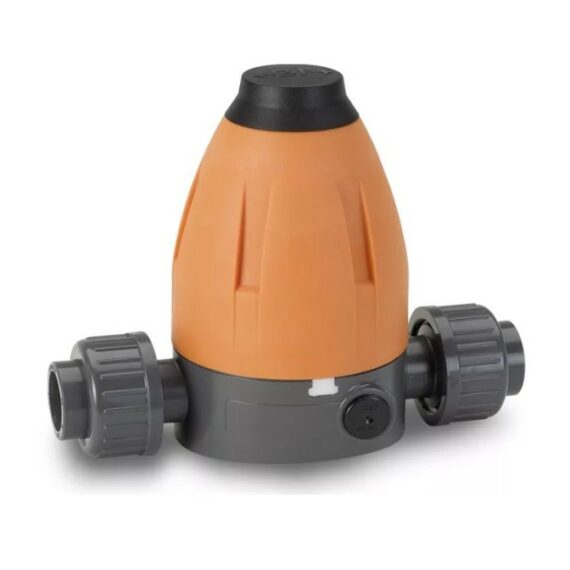
Pressure Reducing Valve – Overview The pressure-reducing valve reduces the outlet pressure to a specified value. Pressure-reducing valves are often used to protect downstream devices against overpressure. The downstream pressure works against the spring resistance and raises the diaphragm until equilibrium is reached. The desired outlet pressure is regulated using the spring pre-tensioning. The inlet pressure is not directly related to the outlet pressure. The pressure at the outlet thus remains constant despite fluctuations at the inlet. The diaphragm is not influenced by pressure peaks, meaning sensitive measuring devices can be protected downstream. The set pressure can be increased by turning the spindle at the top of the valve in a clockwise direction. Turning it counterclockwise reduces the set pressure. Inward-pointing arrows assist in visualising the direction of the flow and the pressure setting, making handling easier. Applications include water treatment, chemical processing, the semiconductor industry and the solar industry. Suitable for neutral and aggressive media with a small amount of particles or solids. Pressure Reducing Valve – Features Constant and stable control behaviour Leak-resistant in the event of temperature fluctuations Low maintenance Pressure setting possible even during operation Easy assembly Compact design allows installation even when space is limited Radially dismountable Integrated assembling aid enables direct assembly of the valve Significantly shorter installation length thanks to union connections Easy operation No re-torquing required thanks to central housing nut Easily adjustable set pressure